
Bored Well vs Drilled Well: What Is the Difference?
A bored well is wide and shallow. It sits in the weathered clay and rock layer above the bedrock and rides the water table. A drilled well is narrow and deep. Its casing is sealed into the rock, and its water comes from fractures deeper down.
That is why a bored well can go dry in a drought and sits closer to surface contamination. It is also why a drilled well is the usual answer when a bored well quits. If an old well cannot be deepened, SCDES says a driller may drill a new, deeper well. For that job, drilling a new well starts with a site survey and a written estimate.
How do a bored well and a drilled well compare?
| Factor | Bored well | Drilled well |
|---|---|---|
| Diameter | Commonly 24 inches or wider | Casing typically 4 to 6 inches |
| Depth | Shallow; the state minimum is over 15 feet | Can go past 1,000 feet; Upstate depths vary job to job |
| Casing | Rock, concrete or ceramic, not continuous | Steel or plastic, sealed into the rock |
| Where the water comes from | The weathered clay and rock layer above the bedrock | Fractures in the bedrock, fed by the layer above |
| Drought risk | Goes dry if the water table drops below its bottom | Reaches deeper water, but a well with no fractures yields little |
| Contamination risk | Higher: shallow, with no continuous casing | Lower, due to depth and continuous casing |
What is a bored well?
South Carolina’s well standards, R.61-71, define a bored well as a large-diameter home or irrigation well. It is commonly 24 inches across or wider. It is typically shallow, with casing made of rock, concrete or ceramic. The state files it as a Type V well, a bored or dug well with a large diameter.
EPA says dug and bored wells are holes in the ground dug by shovel or backhoe. They are lined with stones, brick, tile or other material to keep the walls from caving in.
USGS says dug and bored wells expose a large area to the aquifer. That lets them draw water from less permeable soil, like silt or clay. A 24-inch well also stores more than 23 gallons for each foot of water in it.
How is a drilled well built?
The state calls a drilled rock well a Type I well, an open hole in bedrock. USGS says most modern wells are drilled, with rigs often mounted on big trucks. Rotary bits chew away at the rock, and percussion bits smash it.
Household well casing is steel or plastic pipe, typically 4 to 6 inches across, according to a state health department’s well owner’s handbook. For a drilled home well, R.61-71 says the casing is set into the rock with a watertight seal. Grout fills the space around the casing from at least twenty feet down. Below the casing, the hole stays open in the rock.
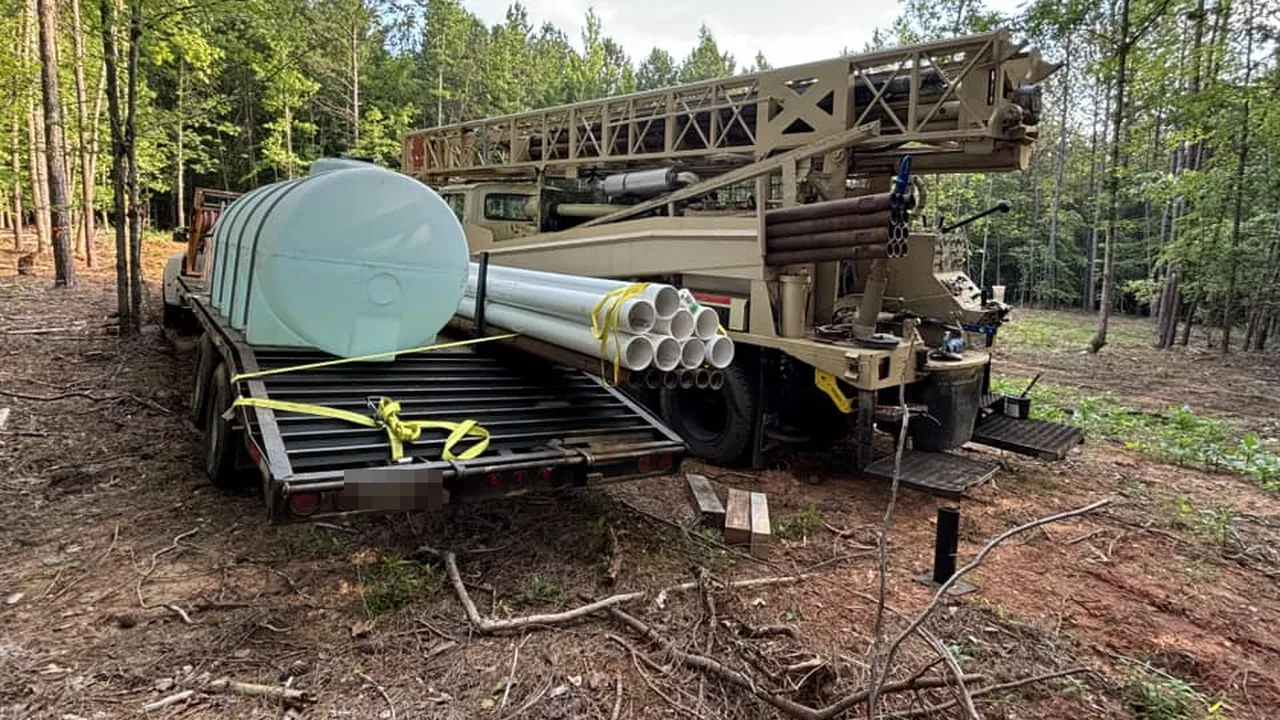
We drill with a truck-mounted rig, backed by a 2,000-gallon water tank truck. We set the casing to bedrock, as the state requires.
How deep does each well go in the Upstate?
A bored well stays shallow. South Carolina’s well standards say a bored well is typically installed at a shallow depth, and it has to go deeper than 15 feet. EPA puts dug wells at about 10 to 30 feet deep.
In the Upstate, USGS describes bedrock under a blanket of loose material called regolith. Most of it is saprolite, a layer of earthy, decomposed rock: the red clay zone a bored well sits in. USGS says it can run 150 feet thick in places, though the thickness varies a lot. The regolith stores the water that feeds fractures in the rock below.
A drilled well goes through that layer and into the rock. USGS says drilled wells can go more than 1,000 feet deep. Here, depth changes job to job. Sometimes we hit water near 200 feet.
On a hard-rock job in Inman, good water showed up a little past 520 feet. The water comes from fractures, and USGS says wells that hit none yield little or no water. That is why nobody can promise a depth, and why our written estimate quotes a minimum.
Why does a bored well go dry in a drought?
A bored well rides the water table. USGS says dug and bored wells go dry in droughts if the water table drops below the well bottom. Any well starts to pump air once the water level falls below its pump intake.
SCDES’s 2026 drought page says South Carolina continues to experience moderate to severe drought conditions. It also says most of the state has plentiful groundwater deeper beneath the ground. When deepening is not possible or worth the cost, SCDES says a driller may drill a new, deeper well.
We posted a job near Lake Greenwood for a family whose well had run dry. If your water just stopped, start with what to check when the well quits.
Which well is more likely to get contaminated?
USGS says dug and bored wells are shallow and lack continuous casing. That leaves them open to contamination from nearby surface sources. EPA says drilled wells have a lower risk of contamination, due to their depth and continuous casing.
EPA advises testing a private well every year. Use a lab that holds certification for drinking water testing.
What pump goes with each well?
USGS says jet pumps are the most common pumps for shallow wells, 25 feet deep or less. They sit above ground and use suction to draw water up. Submersible pumps are the most common pumps for deep private wells. They sit down in the well and push the water up.
The Water Systems Council says pump size is based on the well’s yield and the household’s needs. A household of seven needs more gallons per minute than a household of two.
On a new drilled well, we set the whole pump system, sized to that well. Well pump installation covers the pump, pressure tank, switch and wiring. We also trench a new water line to the house from the new wellhead and hook it up.
What does a new drilled well cost?
One national cost guide puts a complete private well at $3,500 to $15,000. Those are market numbers, not our price list. The guide says depth and the distance from the house drive most of that spread. For the line items, read what it costs to drill a well in South Carolina.
What happens to the old bored well?
State well standards say a bored well must be abandoned right away once it is permanently out of service. Abandoning a well means sealing it under the state rules. SCDES, the agency behind the well permit, can tell you what the rules call for.
The new drilled well needs its own permit. SCDES says all new individual residential wells must be permitted. Our guide to the South Carolina well permit walks through the steps.
Is it time to replace your bored well?
If your bored well runs low in dry spells, a drilled well is the usual fix. We are South Carolina certified well drillers, based in Pacolet, just outside Spartanburg. We work the Upstate about 60 miles around Spartanburg.
It starts with a site survey to help pick the best spot for your new well. Then you get a free estimate in writing, with a quoted minimum depth. Call (864) 768-5688 about a new drilled well, and we will get back to you.