
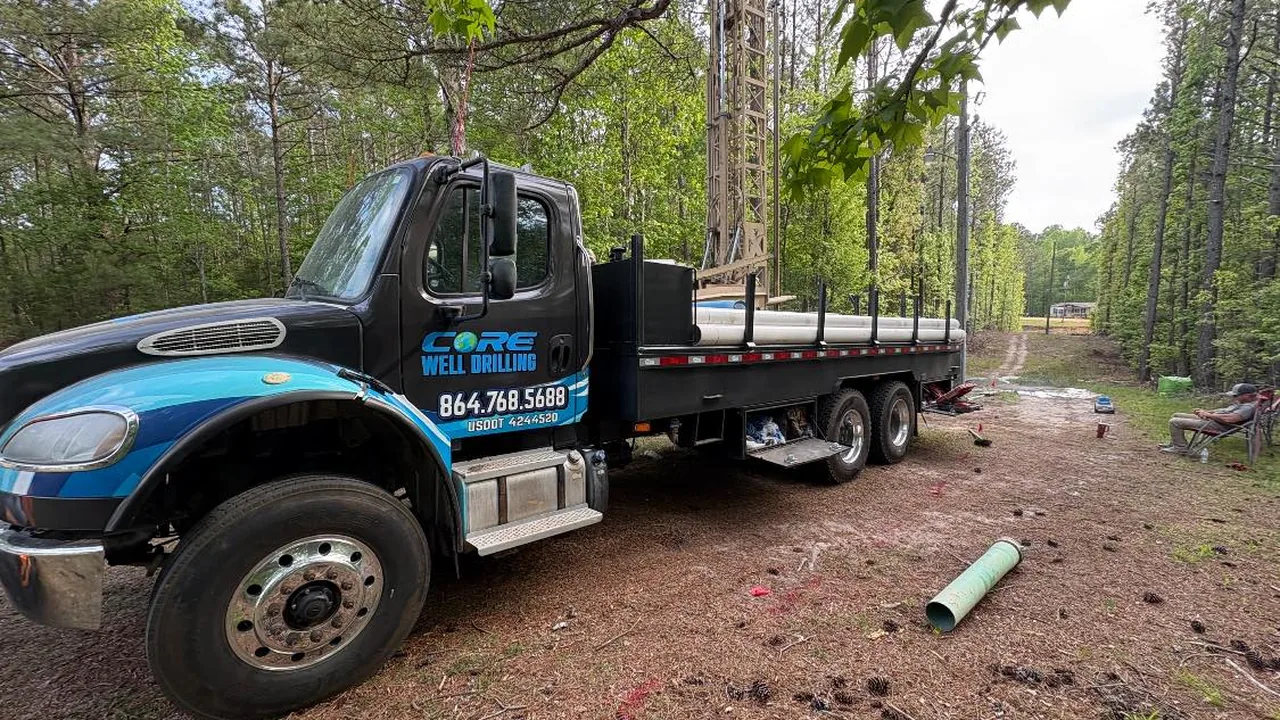
No Water From Your Well? What to Check Before You Call
Most sudden no-water problems come down to four things. Power, the pressure switch, the pressure tank, or the pump itself. A well that has truly run dry sits further down that list, though it climbs in a dry year like this one.
You can check the first of those safely in about five minutes. After that, the parts carry line voltage and the pump hangs hundreds of feet down a hole. The Water Systems Council tells well owners not to attempt these repairs themselves, and that is where well pump repair starts.
Which symptom points to which problem?
One symptom can have more than one cause, so treat this as a starting point.
| Symptom | Check first |
|---|---|
| No water at all, pump silent | Power or the breaker. |
| Pump runs, nothing comes out | Water level or the drop pipe. |
| Pump clicks on and off fast | A waterlogged pressure tank. |
| Faucets spit air, then water | A failed tank or a low well. |
| Breaker trips every time | The motor or its wiring. |
| Water turned muddy, then quit | A dropping water level. |
What should you check first?
Start with power. A house outage, a blown fuse or a tripped breaker stops a pump the same way a dead motor does. The Water Systems Council lists a power failure first among the reasons a well delivers nothing.
Find the breaker marked for the well or the pump. Switch it all the way off, then back on, one time. If water comes back, write down the date and keep an eye on it.
If the breaker trips again the moment you reset it, leave it off and call. Repeated tripping points at the motor, the wiring or the box that starts it.
Could the pressure switch be the problem?
The pressure switch is the small box near the pressure tank that starts and stops the pump. Clemson Extension lists the common settings as 20/40, 30/50 and 40/60 psi. The low number is the cut-in, where the pump starts. The high number is the cut-out, where it stops.
Read the gauge before you touch anything. Zero pressure with a silent pump often means the switch is not closing. A well service manual puts a defective switch high on that list. That is the case when a motor will not start and the fuses stay fine.
Many switches also carry a low pressure cut-off. It shuts the pump down when pressure falls about 10 psi below cut-in. The Water Systems Council says that feature keeps the pump from running dry. When that trips, the pump is being protected from something. Leave the cover on, because the switch carries line voltage.
What does the control box do?
A three-wire submersible motor needs a start relay and a capacitor to get turning. Those parts sit above ground in a control box, usually near the tank, and the Water Systems Council’s Water Systems Handbook describes it exactly that way. Two-wire motors hold their starting parts inside the motor and use no box at all.
When a relay or a capacitor fails, the motor will not start even though the breaker never trips. Control boxes are matched to the motor by voltage and horsepower, and one maker’s box may not suit another maker’s motor. Testing one means working inside a de-energized panel with a meter.
Is the pressure tank the problem?
The tank holds water under pressure so the pump does not start every time someone opens a tap. NGWA says the tank prevents a tremendous amount of wear and tear on the pump. Most household tanks hold 20 to 80 gallons.
A bladder inside the tank keeps the air and the water apart. When it fails, the water absorbs the air and the tank goes waterlogged. The Minnesota Department of Health pairs that fault with the symptom owners notice first: a pump that turns rapidly on and off.
Press the air stem on top of the tank, the way you would a tire valve. Water instead of air means the bladder is finished. Service manuals say to replace a tank in that condition rather than repair it, which makes it a pressure tank replacement rather than a pump job.
The pump runs but no pressure builds. What now?
A pump that runs and delivers nothing has a short list of causes. A well service manual works through them in this order:
- The pump is air locked.
- The water level has dropped below what the pump can supply.
- A check valve is stuck, leaking or installed backward.
- The drop pipe has a leak or a split.
- The intake screen is blocked with sand or mud.
- The impellers are worn from abrasive water.
Every one of those is confirmed by pulling the pump. That is rig work, not something you can read from the wellhead.
If water still comes out but weak, fading or in surges, that is a different problem from no water. Our guide to low water pressure from a well walks through those causes.
Why do the faucets spit air?
Air in the lines has a few usual sources. A tank with a failed bladder can pass air into the line. A well whose level has fallen to the pump intake will pull air along with the water. Some wells carry natural gas in the water, which the Water Systems Council lists as another cause of sputtering.
Fill a pitcher at the tap and watch it before you call. Note the color and whether the water fizzes.
Has the well gone dry?
September is when this tends to show up. A Penn State Extension publication notes that most well problems appear in late summer and early fall, when groundwater sits at its yearly low. Shallow wells feel it first.
The ground is dry here right now. The U.S. Drought Monitor map for the week of September 8, 2026 tells the story. All of Spartanburg County was abnormally dry. About 71 percent of it sat in moderate drought. Upstate wells draw from fractured rock recharged by local rainfall, so a long dry stretch shows up down the hole.
Water turns murky or tastes different, sediment appears, and the spigots cough air until the pump is moving nothing but air. The only sure test is measuring the water level in the well, which takes a contractor with a tape. One warning is worth repeating: never have water trucked in and poured down the well. The Water Systems Council says that can damage the borehole and the pump and contaminate the water.
If the well is dry, SCDES lists the options for South Carolina owners. Lower the pump if water remains deeper in the hole. Deepen the existing well where the rock allows it. Drill a new, deeper well when deepening will not work. Tie onto a public system if the lines reach your road. Which option fits depends on the well’s depth and its casing, and depth varies a lot around here. Two state observation wells in Spartanburg County run 225 feet and 442 feet. Drilling a new well is the last item on that list, not the first.
When should you stop and call?
Stop at the breaker. If the power is on, the breaker holds and there is still no water, the next steps need a meter and usually a pump pull.
Call Core Well Drilling at (864) 768-5688 and describe what you saw. We look at the system, then put the work in a written estimate, and the estimate is free. Cost guides publish wide market ranges for this kind of repair, and what a replacement pump costs walks through them. Those are market numbers, not our price list.